

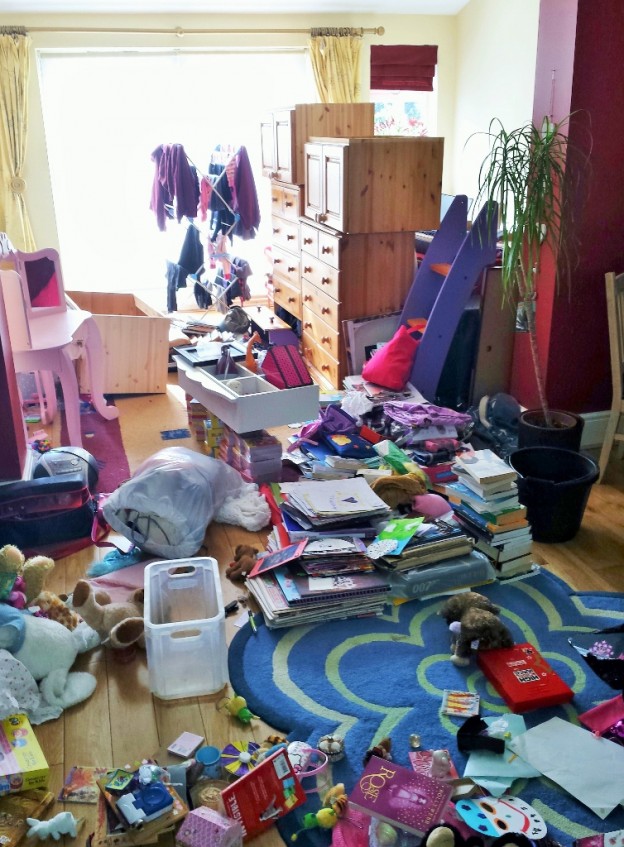
When I tell people what I do, the vast majority say the same two things to me. “I could really do with your help” and “I’m definitely a hoarder.” There are so many misconceptions around clutter and hoarding / hoarding disorder, so I want to explain the differences and outline some of the reasons people struggle.
I could write pages and pages on it but you might lose focus, (if you’re anything like me) so I’ll keep it shortish for now. Most of us live with some level of clutter. A few things out of place, a drawer(s) we avoid opening, a wardrobe that feels a little too full or even stuffed so full it’s never opened. Clutter is part of everyday life, and in many cases it ebbs and flows depending on what’s happening in our world. But hoarding is something different — deeper, more complex, and often tied to emotional or psychological patterns that make letting go feel almost impossible.
Understanding the difference between clutter and hoarding isn’t about labelling people or judging homes. It’s about recognising what someone is experiencing so that support can be given gently, respectfully, and realistically, if and when it’s wanted.
Clutter tends to come from everyday living: busy schedules, unfinished tasks, postponed decisions, or simple lack of storage. It’s the build-up that happens when life demands more from us than our energy can provide. In most cases, although clutter may feel stressful and look messy, your home is still normally functional. You can cook, sleep, move around, and use your spaces, even if it sometimes feels chaotic.
Clutter often grows gradually. A few items are left out “for now”, then a desk or table disappears under paperwork, then washing / ironing piles up during a busy month. The intention to tackle it is usually still there — just not the time or headspace.
Hoarding goes much further than clutter. It involves acquiring and keeping large amounts of items, often to the point where rooms can no longer be used for their intended purpose. Many people with hoarding difficulties struggle with intense emotional attachment to possessions, fear of losing something important, or anxiety around decision-making. Whist it can be things of value, it can also be seemingly innocuous things like newspapers, menus, food labels, empty cans, bottles, literally anything.
Professionally, Hoarding Disorder is recognised as a psychological condition. The NHS and the Mayo Clinic describe it as a persistent difficulty discarding items, regardless of value, combined with significant distress around the idea of letting go (NHS, 2024; Mayo Clinic, 2024).
Hoarding rarely happens suddenly. It can often begin with keeping things “just in case,” saving items with sentimental links, or feeling safer when possessions are close by. Over time, the volume grows until walking through the home becomes difficult, daily tasks become restricted, and health or safety risks appear. This is just an example of how it can develop, Although behaviours can be similar, every person has their own individual factors and there’s never a one size fits all approach from my experience.
Both clutter and hoarding share a common root: overwhelm.
Clutter can grow when life becomes stressful or demanding. Hoarding develops when possessions become tied to comfort, identity, memory, or safety. Letting go isn’t simply about removing objects — it can feel like losing part of yourself.
Here are some common reasons both clutter and hoarding feel so hard to deal with:
Objects can hold memories, hopes, or unfinished stories. Even everyday items can feel important in moments of uncertainty or grief.
Sorting means making hundreds of tiny decisions: Do I need this? Will it be useful? What if I regret letting it go? This can be exhausting, especially for those living with anxiety, ADHD, depression, or trauma.
Many people keep things because they worry about contributing to landfill or believe the item might one day serve a purpose.
When clutter grows, it often becomes a reminder of everything that feels out of control. That can create shame, which then leads to avoidance — creating even more clutter. It can be a horrible vicious circle, the roundabout that feels impossible to jump off.
For people with hoarding tendencies, possessions can feel protective. Items create a buffer from emotional pain, and reducing them can feel threatening.
There is no single “right” way, but there are compassionate, manageable steps that can help.
A single drawer, one bag, or a corner of a room. Success builds confidence.
Rapid clear-outs can feel violating or traumatic, especially for those with hoarding disorder.
Working one type of item at a time — books, clothes, paperwork — reduces decision fatigue.
A calm, non-judgemental friend, a professional organiser, or a therapist can make the process safer and more achievable.
The idea of clear, tidy spaces might be exciting but try and ensure walkways are clear, exits are accessible, and food prep or washing areas are usable.
Decluttering isn’t just a physical task. It can involve identity, grief, change, and vulnerability.
Clutter is normal. Hoarding is human. Both deserve empathy.
Whether you’re dealing with your own home or supporting someone you care about, the most powerful tools are patience, compassion, and tiny, doable steps.
Progress doesn’t have to be perfect (as perfect doesn’t exist)— it only needs to move forward.